Showing posts with label skepticism. Show all posts

Monday, September 30, 2013

My Afternoon at the Mall

I was at the mall the other day to take my computer to the Apple Store. My Macbook has been having problems, and I figured it was time to let the Geniuses handle it. I'm not being snide, here; that's what the employees at the Apple Store are called: geniuses. I had an appointment, and I was about twenty minutes early.

I parked as close as I could, which — as usual — was at the Belk store closest to the Apple Store. I successfully threaded the competing displays of Halloween and Christmas (Honestly, does this not make anyone else sick?) and made my way upstairs so I could go directly from the Belk just around the corner to the Apple Store.

As I walked through the mall, I noticed a big crowd of people downstairs from me. There was a lot of murmuring, squealing, and flash bulbs. But I didn't have time to loiter.

I made it to the Apple Store just in time for my appointment. I gave The Shiny (my MacBook) to the nice, bearded young man (Is there some rule that male Apple Geniuses all have to have beards?) named Paul. I explained what was going on with the computer and he said he would plug the diagnostic tool into it and let me know if it was something easy, like the graphics card or a bad USB port. Something fixable.

The Apple store was crawling alive with people. Must be something about the end of the month or back to school or something. He told me it would take about an hour if I wanted to wait. Well, of course I want to wait. I can't leave The Shiny overnight.

The withdrawal would be unbearable. :)

I couldn't stand being in the Apple store with all those people, so I wandered back down toward where there are some couches to sit and read on my phone.

I heard that crowd down below again, and figured, "Eh, what the hell. I have time to at least take a look."

There was a large crowd of mostly adults, but some older kids, and frequent flashes from cameras and squeals of delight. "Gotta be puppies or kittens or something," I murmured. "Maybe the ASPCA is sponsoring adoptions."

Then I saw the bright pink sign. A big cartoon close-up of a smiling, toothless baby, its blue eyes practically luminous. Underneath, it said, "PHOTOGRAPH WITH A BABY - $15"

"What the . . . ?" I edged a little closer to see what was going on.

There was a large, fenced-off enclosure. Inside there was a floor that looked like Pergo or linoleum of some kind. The floor was scattered with assorted toys, all brightly colored. Also inside the cage were a bunch of babies.

Yes. Naked babies of all races and both genders. They all looked to be of crawling age, although quite a few of them weren't crawling. Some of them were piled together, dozing, in a big pile of stuffed animals. Others were crawling lazily around on the floor. Adults wearing pink shirts were on their knees cooing to the babies, shaking toys at them and trying to attract their attention.

Dumbfounded, I pushed in a little closer, and got called a very unpleasant name by an older lady whom I apparently offended. I was just in time to see a woman with a couple of older teenagers point at a little Asian baby girl hesitantly crawling away from one of the pink-shirted adults with toys toward the pile of dozing babies.

A man standing in the gate gestured to the baby the woman had pointed at and raised his eyebrows. "That one?"

"Yes!" the woman exclaimed, bouncing on her toes. The man turned away and I heard her say to her two children, "Oh, isn't she just the most adorable little thing?" The boy rolled his eyes.

The man went over to the baby girl and unceremoniously picked her up. She started crying, but the guy held her under her arms, bouncing her up and down, and blowing in her face until she grimaced toothlessly.

"I don't want that one if she's going to be crying," said the woman with the two kids. She was frowning and both of her kids were starting to complain.

"Mom, what if she spits up?" one of them asked.

"Hush," she said. "These people know what they're doing, honey."

The man inside the cage must have overheard her. He smiled. "Don't worry, ma'am. I'm resetting her, now. She'll be ready for your picture."

I looked at the baby girl more closely. I could see her ribs, and it was clear from her pallor that she wasn't healthy. Snot ran out of her nose, and from the look of it, she was either drugged or so sleepy that her eyes were barely open, and her head lolled.

Meanwhile, other people were pointing at other babies. Some of them were waked from a sound sleep and, if they cried, given the same treatment as the little Asian girl. A couple were slapped on their bare buttocks or on the face to wake them up.

At one end of the cage was a mock-up of an idealized nursery. Rocking chair, toys, building blocks — it looked like a perfect baby's perfect room, right out of a movie set.

The woman and her two teenagers were led into that end of the cage and the teenage girl sat in the rocking chair, first.

"How do you want her?" asked the man, still holding the feebly protesting baby girl.

"Ew. I don't want her all naked. Can you put a dress on her, maybe? Or a bonnet? Her hair is ugly."

Her hair was, indeed, ugly. Matted to her skin and patchy.

I watched while the man expertly draped a too-large "dickie" of a bright pink, frilly dress around the squirming baby, and then tied a bonnet over her hair. It looked to me like he tied it too tight.

He roughly wiped the snot from the baby's face with a towel of questionable cleanliness and handed the baby to the girl, who held her awkwardly under the arms with both hands, a look of terror in her eyes.

The man stepped up and said, "No, like this." And he showed her how to hold the baby on her lap so that her face was toward the camera. "Do you want a bottle, or just go like this?"

"Like this," the girl said firmly.

The baby's head lolled and I could tell even from where I was that she was sleepy. The man grabbed her roughly and bounced her until she opened her eyes and blearily looked back at him. He then handed her back to the girl, arranged the dress and bonnet, and quickly stepped back to operate the camera.

Just a second before he snapped the photo, the teenager shrieked. "Ew! Oh, my God, mom! She peed on me!" The girl shoved the now-dripping baby away from her at arm's length.

The man sighed and came and took the crying baby. "Do you want me to get another one?" he asked.

The mother looked ready to spit nails. "No, we do not want another one!" She grabbed her daughter's hand and said, "Come on, Chelsea. Let's go get you cleaned up." She practically dragged the girl from the cage, followed by her younger brother.

The guy inside the cage ripped the dress dickie off the baby, pulled off the bonnet, and tossed the sodden pair into a bin. He handed the now wailing baby to another man, who held her up by one arm and sprayed her with a hose. I could smell the disinfectant from all the way across the cage. The baby was now wailing and crying loudly. I guess the water was cold.

I felt faint and ill. What the hell was going on, here? Was this even legal?

I elbowed my way back out of the crowd and worked my way around to the side where another employee of whatever this place was stood. He was wearing a pink shirt like all the others, complete with a grinning baby-head logo on the pocket.

"Excuse me," I said.

"You'll have to go to the end of the line, like everyone else, sir," he said without even looking up.

"No, I'm not in line. I just have a question."

He looked up at me, annoyance clear on his face. "Yeah?"

"Where are these children's mothers? I mean, are they — ?"

"It's all in the brochure." He shoved a glossy brochure at me. I backed out of the crowd and went to stand a few feet away near a support column and took a look at it.

"VAN DUREN FOSTER HOME" was emblazoned across the top in neon blue lettering. I quickly thumbed through it. Pictures of happy, grinning, fat babies being held and fed by what looked like older teens. Nothing like what was going on scant feet from me.

I started reading. They claimed to rescue homeless teens. They provide them sanctuary — a safe place to live, medical care, room, board, and clothing. Help them kick drug habits. Educate them. And any children born to them during their stay are taken to foster care, and also "displayed for public education and entertainment."

What?

So that's what this was. I wondered if the parents of these babies even knew what was happening to their children. I felt sick to my stomach. I ripped the brochure in two and looked for a trash can. How on earth can they legally keep this up? Why aren't there laws?

"Sir?" I turned around to face the voice as someone tapped me on the shoulder. An older woman smiled at me, crows feet around kind, brown eyes. "You look like you could use this." She held out a cup of water.

I took it. My hand was shaking. "Thanks," I said, then took a sip.

She held out a hand and I took it. "My name is Tricia Phillips. We're here protesting." We shook hands and she gestured toward a small group of about seven people standing over to one side, carrying signs. And being ignored.

She led me over to her group. They all welcomed me warmly, then showed me pictures they had of the Van Duren foster home. Teenagers living in barbaric conditions, not much better than packing crates. Barely big enough to move around in. No heat or air conditioning. Mud everywhere. Open latrines swarming with buzzing flies. It looked like a third-world refugee camp. No trees or any kind of shade. The teens' eyes looked dull and lifeless in the photos. Haunted.

"Those were taken about a week ago," Ms. Phillips explained. "A couple of former employees of Van Duren smuggled the pictures out to us."

As I flipped through the pictures, I noticed that most of the girls were pregnant. I commented on it.

"Yes, well . . . where do you think these babies come from?"

I felt sick again. "They're breeding them?"

She nodded, compassion in her eyes. "Some of these poor children are related, but Van Duren doesn't even care. They encourage them do whatever they want. We suspect they're drugged most of the time and aren't even aware of what they're doing."

"Holy shit," I said. "Isn't this illegal?"

She smiled sadly. "Well, of course it is. There are all kinds of laws, but they're seldom enforced."

I couldn't take my eyes off the pictures of the pregnant teenagers. So young. "What happens when, when . . . ?" I choked on the bile in my throat.

"Turned back out onto the streets. The infants used in these awful mall things end up in foster homes or wards of the state or worse. There are child pornography rings that pay good money for children as young as eighteen months."


I'm going to stop here. At what point did you figure out I was writing fiction? Are you appalled? Disgusted? Infuriated? Do you want to call me terrible things for being sick enough to come up with something this disgusting?

Because guess what? Take out the human babies and the homeless teens being raised as breeding stock and substitute tigers, and it's all true.

You read that right. All true.

There are places that set up in malls that allow the public to pay to have pictures taken with tiger cubs. Cubs that are very young and need proper nutrition, enough sleep, and whose immune systems aren't strong, yet.

These poor, innocent creatures are bred ruthlessly by people who claim to be "rescues" who operate "sanctuaries" for big cats. They claim to be working with conservation efforts, and that the only way to raise money for their good work is to take these cubs around for public display.

They claim that the cubs enjoy it. That blowing in their face calms them down. That holding them dangling from under their front arms and bouncing them up and down "resets" them. (What does that even mean?) That constantly being poked, prodded, handled, and grabbed by dozens of people, day in and day out for weeks at a time isn't harmful to them. That bright lights and flash bulbs aren't harmful to their sensitive eyes. They claim that they're well fed. That's it's 100% safe for humans and the cubs.

That the exhibitor is doing this to "teach people" not to have exotic animals as pets.

And they tell people that the cats will go to good homes when they get too big for petting.

Lies.

The reality is very different. They're kept in tiny cages, forced to breed constantly, and since white tigers are popular, they inbreed their stock to produce more of them. When they get too old, the cubs end up in roadside "zoos" where they are forced to lie on hot concrete in direct sun year round in a cage barely big enough to stand up or turn around in. Fed insufficiently and incorrectly. Given no shelter.

Often, they are killed for their fur and the body is cut up and sold illegally. There is good money to be made on the black market selling tiger parts, where they are prized for their supposedly magical properties. There are still countries in which the fur trade has no limits to the types of animals that can be used.

These cubs are torn from their mothers too early, causing distress to both the cubs and their mothers. They're not allowed to imprint naturally on their mothers, but instead imprint on their human captors. Babies of any species need lots of sleep, but these are not allowed to get enough. They are constantly poked and prodded to be kept awake. Tiger cubs want to explore instinctively. But when they try, they're restrained. They spend hours in small cages inside trucks being carted from place to place so people can have their pictures taken while petting or feeding them.

The cubs are constantly sick and often have diarrhea, which goes untreated, so the cubs are irritable and in pain from the constant wiping by their human captors. Those cute little "roars" are screams of pain.

I get apoplectic with rage over this. I've been trying to come up with a way to show how awful it is, and I finally came up with this. I hope it makes you think, next time you hear of one of these events. If you've ever been to one, stop. If you know people who do, show them this post. If a mall near you advertises such an event, contact the owners. Let them know what is really going on. Encourage them to pass.

And hopefully, everyone who reads this will follow this link to an article entitled "The Truth About Tiger Cub Petting Displays in Malls" from Big Cat Rescue, which is where I got most of the details for my little story above. No infringement is intended. Any mistakes in facts are mine, not theirs.

I'm not affiliated with BCR in any way other than that I contribute to them, and try to spread the word like I'm doing right now. I love big cats, and it makes me furious to hear how they're being mistreated. They're such beautiful, powerful, amazing animals, and yet . . . we treat them like garbage. But I believe it's mostly out of ignorance that we still permit this kind of thing to occur. We still want to believe the best of people, and when we're told that it's safe for the animals and that they're being taken care of, and all the money is for research and conservation, we want to believe it.

There is actually one part of the fictitious tale of human baby petting zoos that is complete fiction and is not based on the plight of these tiger cubs. There are few laws against this, or very few. There are laws, for instance, that regulate the ages at which these creatures can be exploited: 8 weeks to 12 weeks. Yet it is commonplace for these tiger petting zoos to ignore the regulations, because resources for enforcement are limited.

But there are bills in Congress to prevent any private ownership of several species of big cats. You can help get these laws passed. Contact your congressperson and representative.

Thank you for indulging me this far, and I do hope you'll keep this in mind for the future.

Thank you for reading.

Disclaimer: All names used are fictitious and any resemblance to any person, living or dead, is unintentional. The names Belk® and Apple® are used to set up the framing story and are in no way affiliated or associated in any way with the kind of practice portrayed herein. As far as I know, there is no such place as Van Duren Foster Home, and the fictitious name was picked at random. If any such place exists, I apologize and will change the name. Big Cat Rescue does exist, and as stated, I am not affiliated with them in any way whatsoever. They had no prior knowledge of this post and were not consulted before publishing.


Thursday, August 22, 2013

What Faith Means to Me

I've written before about what I believe might be the first, tentative steps into realizing what I consider to be one of the defining truths of my life: that there is no God or gods.

But that's only part of the story. There's also that moment when I realized I wasn't alone. That there was a name for people such as myself. And that there were a lot of us out there. And that word was "skeptic."

I have always read voraciously. It started at an early age. We'd get The Weekly Reader at my school, and a couple of times each year, they'd have a page where you could go through a bunch of books they offered and check them off. The teacher would collect everyone's order sheet — and a check from their parents — and send them off. A few weeks later, we'd all get our books.

The other kids in my class would get one or two. I'd get eight to ten. And I'd read them almost as soon as I got them home.

At around age nine, I became fascinated by the occult. Ghosts, aliens, poltergeists, bigfoot, the Loch Ness Monster, the Bermuda Triangle, Atlantis, the Nazca lines . . . you name it, I probably believed it and read at least one book about it. (Well, except vampires and werewolves. Those were never on my radar.)

I scared the crap out of myself. Convinced myself that my house was haunted. That aliens were abducting people left and right and I might be next. That Bigfoot might be wandering around in the forest right behind my house. That every sound in my house at night was something unspeakable coming specifically to get me.

I didn't sleep a lot. :)

I eventually expanded my literary palate to include science fiction, fantasy, and horror. I read my first Steven King novel (The Shining) at age twelve. My pendulum swung all the way over in the other direction from belief and I started to realize that the things that seemed so plausible at nine or ten were silly and rather childish from the vantage point of the advanced age of twelve. I mean, come on. Erich von Daniken's ancient aliens were about as likely as . . . as a plesiosaur alive after 65 million years in a murky lake in Scotland.

I got completely away from non-fiction1 and consumed only fiction for many years. I must have been in my late twenties or early thirties when I picked up two books written by Carl Sagan. I had done another one of those turn-arounds and was now heavily into non-fiction2: science, psychology, self-help (I know, I know . . . skepticism is a process), that kind of thing.

Then, I read a book called The Demon-Haunted World, and the world made so much more sense. I had a category to put myself in. Not only could I confidently say, "I'm an atheist," I could also now confidently state, "I am a skeptic."

And then I read Pale Blue Dot.

There's one passage from the book that never fails to bring a tear to my eye. It is so beautifully, passionately written. It transcends science and literature and speaks directly to the heart, as it were.

But first, some background. The year was 1990. The Voyager 1 spacecraft had completed its primary mission after twelve years and was about to depart the solar system forever. Dr. Carl Sagan, realizing that it was likely we would never again get the chance to get a "family portrait" of the Solar system from that vantage point, managed to convince NASA that they needed to turn the craft around and have it take a picture of all visible planets (Earth, Venus, Neptune, Uranus, Jupiter, and Saturn) from the perspective of six billion kilometers away from Earth.

That's 6,000,000,000 kilometers — approximately 3.7 billion miles. So far away, messages from Voyager 1 to Earth took nearly 5.5 hours to reach us at the speed of light.

NASA agreed. They captured images of the outer planets first, fearing that by aiming their cameras too close to the sun to include Earth and Venus, they would damage the camera. And then, finally, they aimed their camera at Earth.

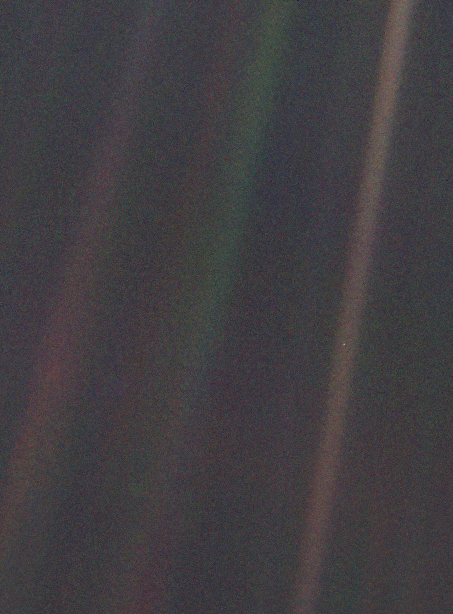
The resulting image is the one we now call The Pale Blue Dot. You can see it up at the top of this post. Click it and you'll go to a larger version of it.

That brown streak is an artifact of how close to the sun the cameras were aimed in order to capture Earth. It isn't a real structure.

What is real is that tiny blue pixel in the streak. That tiny blue point of light — smaller than a full pixel — is Earth.

Here are Dr. Sagan's words. The ones that bring a tear to my eye.

From this distant vantage point, the Earth might not seem of any particular interest. But for us, it's different. Consider again that dot. That's here. That's home. That's us. On it everyone you love, everyone you know, everyone you ever heard of, every human being who ever was, lived out their lives. The aggregate of our joy and suffering, thousands of confident religions, ideologies, and economic doctrines, every hunter and forager, every hero and coward, every creator and destroyer of civilization, every king and peasant, every young couple in love, every mother and father, hopeful child, inventor and explorer, every teacher of morals, every corrupt politician, every "superstar," every "supreme leader," every saint and sinner in the history of our species lived there – on a mote of dust suspended in a sunbeam.

The Earth is a very small stage in a vast cosmic arena. Think of the rivers of blood spilled by all those generals and emperors so that in glory and triumph they could become the momentary masters of a fraction of a dot. Think of the endless cruelties visited by the inhabitants of one corner of this pixel on the scarcely distinguishable inhabitants of some other corner. How frequent their misunderstandings, how eager they are to kill one another, how fervent their hatreds. Our posturings, our imagined self-importance, the delusion that we have some privileged position in the universe, are challenged by this point of pale light. Our planet is a lonely speck in the great enveloping cosmic dark. In our obscurity – in all this vastness – there is no hint that help will come from elsewhere to save us from ourselves.

The Earth is the only world known, so far, to harbor life. There is nowhere else, at least in the near future, to which our species could migrate. Visit, yes. Settle, not yet. Like it or not, for the moment, the Earth is where we make our stand. It has been said that astronomy is a humbling and character-building experience. There is perhaps no better demonstration of the folly of human conceits than this distant image of our tiny world. To me, it underscores our responsibility to deal more kindly with one another and to preserve and cherish the pale blue dot, the only home we've ever known.

To me, those three paragraphs pretty much sum up my view of our place in the universe. Why it's so important to further our knowledge and turn away from unprovable beliefs and ideologies that do nothing but stifle progress in the name of petty arguments over what amounts to nothing. Belief isn't going to save mankind from whatever our species' eventual fate might be, whether it's extinction by our own hands or something we have no control over, like a new disease, environmental disaster, or a big rock hitting our planet.

Science might. There are no guarantees. But there is no evidence that anyone is watching over us, ready to save us if we just know the right words to use when asking. Or ready to punish the entirety of our species for the infractions of a small percentage because of some foolish, petty whimsy. "You don't deserve to live, because you ate meat on a Friday. Pushed a button. Wore two kinds of fabric. Ate meat from the wrong animal. Loved the wrong person. Didn't bow to the east to recite your prayers. Listened to the wrong leader. Drank the wrong drink. Thought the wrong thoughts. Believed the wrong things."

If we're going to survive, it will be because men and women of science, not faith3, figured it out. And that is what I have faith4 in.


Today's post is inspired by GBE2 (Group Blogging Experience)'s Week 115 prompt: Faith.
  1. I realize now that categorizing these books as 'non-fiction' is laughable, but at the time, that is how they were marketed. Which is one reason I probably had such a protracted period of time when I believed whole-heartedly in such nonsense: after all, "They" wouldn't allow a book to claim it was non-fiction if it wasn't, would They?
  2. Actual non-fiction! Like Carl Sagan's books and stuff by people with real edumacashuns and degrees from universities that aren't made up. People who have Science and Data to back up their claims instead of a lot of supposition and things they have extracted from their own asses.
  3. As in belief with no evidence — or even in defiance of evidence to the contrary — which is what is usually meant when used in this sense.
  4. Evidence-based trust, as in, "I have faith the sun will rise tomorrow," because we have scientific evidence, not because someone sang it into the sky or sacrificed a virgin to it or prayed it out of the darkness.

Wednesday, May 29, 2013

You Done STEPPED in it Now

Earlier this week, Pope Francis I made history by announcing that not only do all good people go to heaven (stating that, basically, good acts are what count), this included, of all people, atheists.

Gasp! The scandal!

A lot of atheists were quite amused by this. “Yay, we’re not going to the imaginary happy place instead of not going to the imaginary bad place!”

I, personally, view the Pope’s announcement as roughly equivalent to Bugs Bunny telling me I’ll go to Los Ang-ga-leez after I die, but only if I take a left turn at Albuquerque.

But not long after the Pope made his announcement, the Vatican contradicted this.

[T]he Rev. Thomas Rosica, a Vatican spokesman, said that people who know about the Catholic church “cannot be saved” if they “refuse to enter her or remain in her.

(Translation: Atheists are going to Hell if they don’t accept Jesus Christ as Lord and Saviour.) [emphasis added]

I’m mighty glad the article provided that translation, because otherwise I might have thought he was implying something else altogether. If you know what I mean. Nudge-nudge.

But let’s ignore that. As I said, I find the whole thing kind of amusing. Sort of the same way a Christian would if a Native American shaman told them they would not be able to enter the Happy Hunting Ground because they were not Cherokee (or whatever). “Oh, that’s nice.” <polite smile>

What I’m curious about is this whole papal infallibility thing. You know, the doctrine that states that whatever the Pope says is what the church believes?

From Wikipedia, the bastion of all knowledge:

Papal infallibility is a dogma of the Catholic Church which states that, in virtue of the promise of Jesus to Peter, the Pope is preserved from the possibility of error "when, in the exercise of his office as shepherd and teacher of all Christians, in virtue of his supreme apostolic authority, he defines a doctrine concerning faith or morals to be held by the whole Church.” [emphasis added]

<insert screeching tire noise here>

So, how does this work, exactly? The pope, Il Papa, The Dude with the Funny Hat himself, comes out and proclaims, “Anyone who does good can get into Heaven,” this should mean that from that point forward (Or is it retroactive?), this is the doctrine of the entire Catholic church. (Until the next infallible Pope says the opposite, anyway.) No ifs, ands, or buts about it:1 if The Pope says it, that’s the way it is.

Except that then the Vatican – represented by a priest who is not the Pope – comes out a few days later and says, “Wait, no. The Pope was wrong.”

<insert sound of game show buzzer here>

“Oh, I’m sorry. You forgot to state the doctrine in the form of a papal proclamation.”

To me, this is a much more interesting question than whether people who don’t believe are or are not going to a place they don’t believe in after they die. Is the church abandoning papal infallibility? Was it ever a thing? Am I misinterpreting something?2

Or is this, indeed, a big doctrinal, dogmatic deal?

What are your thoughts?


  1. I believe this is the basis for papal infallibility, or at least that’s what Professor Wiki tells me: Matthew 16:18 And I say also unto thee, That thou art Peter, and upon this rock I will build my church; and the gates of hell shall not prevail against it. 19 And I will give unto thee the keys of the kingdom of heaven: and whatsoever thou shalt bind on earth shall be bound in heaven: and whatsoever thou shalt loose on earth shall be loosed in heaven. [emphasis added, clearly]
  2. I am quite aware of this, also from Wikipedia: "A doctrine proposed by a pope as his own opinion, not solemnly proclaimed as a doctrine of the Church, may be rejected as false, even if it is on a matter of faith and morals, and even more any view he expresses on other matters." So, yeah, all they have to do is say it was his opinion or that he was not making a binding claim and they're off the hook, but I find this loophole kind of hypocritical. Don't you think? I mean, a Pope either is or is not infallible. If he can make one mistake, doesn't that mean he is, pretty much by definition, fallible?

Friday, January 18, 2013

Improbability

"The universe is so fined-tuned for intelligent life that there's just no way all that could have 'just happened' randomly! There had to be a guiding force!"

Take a deck of 52 standard playing cards (remove the jokers and any ad cards), or, if you have them handy, you could use a standard deck of 78 tarot cards as well. If you want to be evil and possibly murder some random person.

I keed, I keed! You won't cause random murder with a tarot deck. Probably.

Shuffle them at least six times to ensure a more random order. (Seven if using the tarot deck.)

Cut the deck. Or don't. I don't really care.

Now, deal the cards out one at a time, face-up, on a table, floor, or other flat surface so that you can see all the cards.

When you're done, carefully examine the order of the cards that you've laid out, from left to right.

That particular sequence of cards that you laid out was so improbable that it was impossible, by all practical definitions of the word. It had roughly a 1 in 8.06582 x 1067 chance of occurring! (Or 1 in ~1.13243 x 10115 if you used the tarot deck.) If a machine that could sort and deal the entire deck of cards in one second were to start doing so at the moment of the big bang, it still would not have exhausted all the possible combinations of cards in the 52-card deck, much less the 78-card tarot deck. The universe is only a bit over 432 quadrillion seconds old. That's ~ 4.3233 x 10¹⁷ seconds. You'll notice that 17 is much smaller than both 67 and 115.

And yet, this extremely improable event occurred right before your eyes. You watched it unfold before you! How astounding! You've just witnessed something that has almost certainly never occurred before, and will almost certainly never occur again in the history of the universe.

Do you feel privileged? As though you've witnessed a miracle that requires a "guiding hand" from elsewhere so that it aligned just right?

Eh, probably not. I mean, it's just random card order, right?

People tend to ascribe higher "impossibility" to sequences of events that mean something to them. Like flipping a coin a hundred times and coming up with heads every single time. In reality, any sequence of a hundred flips of the coin is equally unlikely as a hundred heads, a hundred tails, or fifty of each, intermingled (HTHT . . .).

Admit it: if you did the shuffle-then-layout thing and the cards managed to be in order from ace to king by suit (spades, hearts, diamonds, then clubs), or in a similar order for the Tarot cards, with the minor arcana first by number and suit, followed by the major arcana, you'd be much more likely to get a cold chill up your spine. But those "special" arrangements are exactly as likely — or as unlikely — as any other one.

Or if you shredded a catalog into confetti, then tossed it all up into the air over a fan, and as the pieces drifted to the ground, it happened to form an image that looked like Jesus or the virgin Mary, suddenly, it's a miracle! Whereas, if it formed the equally unlikely picture of, say, Flo the cashier from those Progressive Insurance commercials or Pepe le Pew, the Loony Toons skunk, it would be kind of neat . . . but hardly miraculous. They only seem miraculous because the image formed means something to us.

If it actually formed the unmistakable image of anything, I'd be highly suspicious. That our brains see patterns where there aren't any is called "pareidolia," and it's a well-known explanation for such things as Jesus-tortillas or Virgin-Mary-grilled-cheese-sandwiches.1

This is why I tend to be scornful when I hear things like "the universe has to have had a creator because there's no way everything just happened to line up to allow our kind of life!" If you look into it a bit, you realize that there's more beauty to the universe without a guiding intelligence than with one, or at least that's how I see it.


  1. Frankly, the Virgin Mary grilled cheese (see the image at the top of this post) doesn't look like much of anything to me, but sometimes I can sort of see an image of Tracy Scoggins, if I look slightly to one side and squint. And it's dark enough. And someone tells me I'm supposed to see Mary/Tracy.

Monday, September 10, 2012

Skepticism in Unexpected Places

Words of Wisdom

Back in June, I was accepted into a week-long writing workshop called Viable Paradise. It takes place the second week of October, 2012. I'm quivering with anticipation. Since then, I've been reading suggested works by the instructors (all published authors & editors) to get some idea of what their styles are like.

I was reading Theresa Nielsen Hayden's Making Book, a book of essays that I didn't expect to like, but which I do.

On pages 101 and 102, I came across these gems.

  1. Never take on the necessity of a negative proof, or argue with someone about their own thoughts and intentions.
  2. Causality is lots of fun to think about, but is never at home when you phone. Correlation isn't as attractive at first, but is friendlier; you can call up and make a date.
  3. Keep a close eye on violations of statistical probability, but bear in mind that you yourself must always constitute an inadequate sample.
  4. The tidier a story is, the less I tend to believe it. I can't demonstrate that this is necessarily effective, but so far it's never steered me wrong.
  5. And watch out for eyewitness accounts that, on consideration, require the eyewitness to have been standing in an unlikely position relative to the alleged events.
  6. Watch out for thought systems that have built-in explanations, valid within the terms of the system, for why someone disagreeing with that system is doing so and is wrong.
  7. You can't logically refute bullshit.

[Any misspellings or typos are entirely my own responsibility.]

Wow. There were a few others I left out that were less applicable to the idea of skepticism. And I'm quoting this without any permission whatsoever and if asked, I will take it down (albeit with much pouting).

But my point in posting it is that Ms. Nielsen Hayden says these points better than I see them explicated on many a skeptical website that spends many thousands of words saying the same things.

First, I cannot tell you how many times I've encountered someone online telling me what my thoughts and intentions are. Thoroughly convinced, these people are, of what goes on in my head; but it's obvious to me from the way they argue their case that they have little to no idea what goes on inside their own skulls, much less mine. You can doubt someone's stated thoughts and intentions, but keep your mouth shut. You do not actually know what goes on inside another person's mind. And if you can prove you do, please apply for the 1 million dollar prize offered by the James Randi Educational Foundation (JREF). The Nobel Prize will follow, as well.

The second one is brilliant. It humorously states the skeptical mantra of "correlation does not equal causation," but does it in a way that makes one smile instead of glaze over in boredom and oh look a butterfly and I need to pick up milk and bread and did I turn off the iron?

The third one I take as an exhortation against making the "Argument from Ignorance" fallacy and pareidolia, all in one admonishment. (Argument from ignorance shows up a lot. You can recognize it by listening for the key phrase, "I don't see how that can be true.")

The fourth one is also quite brilliant, to me. It neatly unties all the connections of every conspiracy theory that I've ever heard. All of them manage to explain everything from inside the bubble of whatever premise the believer adheres to. If something sounds too good to be true, then it probably is. Real life is seldom (not never, but seldom) that tidy.

Number five is great. Sometimes, you'll hear someone talk about how they saw thus-and-such with their own eyes (Could they see it with someone else's eyes?) and therefore it totally happened exactly as I said so there. And then later, you find yourself in a position to examine the story and you realize that to have seen what they claimed to have seen, they would have had to be somewhere improbable or impossible, such as in two places at once, or hovering in mid-air above. This one is easy to fall into, as well. Our brains love stories – crave them, even – and if something doesn't make sense, our brain will conveniently fill in details that we never actually saw.

Number six, though . . . Number six is why I decided to write this post. OMFSM, I can't even estimate how many times I encounter this. "You just hate God, and you're lashing out at Him." "You had a bad experience as a child and now you're rebelling against the Church." "You're denying what you know in your heart is true. Why don't you just admit you're wrong?" Recognize it? I'll bet every atheist has heard one or more of those on more than one occasion. Because you don't believe what the speaker believes, they have to come up with some rationalization that fits inside their own belief paradigm to make it make sense to them why you don't agree with what they see as self-evident. Our brains hate cognitive dissonance, and will go to almost any length to get rid of it.

Or how about, "You've been brainwashed by the ______, and you just won't let yourself hear the truth." That one comes from most conspiracy theorists, and people who wholeheartedly believe in some form of quack medicine, like homeopathy or iridology.

Make no mistake, though: I've heard number six from atheists and skeptics, as well. We accuse believers of being too stupid or closed-minded to see what's so obvious to us.

And then we arrive at number seven, which I often hear stated as "You can't reason someone out of a position they didn't reason themselves into." In other words, no amount of reason is going to talk someone out of their belief/faith. It just isn't. The very best you can hope for is to present your case to them and let them follow the path on their own if they're interested. It has happened. People have heard skeptical podcasts like the Skeptics Guide to the Universe, for instance, and have sent letters later saying, "Something you said in an episode made me wonder, so I started researching, and now I'm a skeptic."

But the change had to come from within themselves, not from without. Another way of stating this one goes around FaceBook from time to time as a silly meme: "'Your constant yelling and screaming at me about how wrong I am totally convinced me,' said no one, ever."

So even if I remember not one other word Ms. Nielsen Hayden said, I'll always have these words of wisdom to remind me of this little book of essays.

Tuesday, February 09, 2010

Coincidences

It's easy to see why it is that so many people believe that Everything Happens For A Reason™.

"Everything Happens For A Reason," they say, especially after you've just told them a bit of bad news.

"I fell down some stairs and shattered my kneecap," you might say.

"Oh, that's terrible!" they exclaim. And then they add, "But, you know, Everything Happens For A Reason."

And you can't argue with them by asking, "What possible, sensible reason could there be for me shattering my kneecap?" because it usually just starts a discussion that you can't win about the motives of some god, God, the universe, Fate, or whatever Big Controlling Influence they happen to subscribe to.

Our brains are hard-wired to look for patterns. We see them everywhere, every day. And sometimes, we see them when they aren't there (pareidolia with maybe some apophenia added, to taste).

A perfect case in point is what just happened to me during lunch, and I found myself actually looking for the chain of coincidences that led to it. Because I couldn't help myself; it's human nature. :)

Last night, I decided to have chili from Los Arcos for dinner. I love their chili, and it's quiet and never crowded, and makes a great place to read.

As a result, I stayed up a little later than normal because my stomach was slightly upset. (I love their chili, but it doesn't always love me.)

Before I went to bed, I shoved a few unread books into my bag so I would have a choice of what new book to start today.

As a result of the late bedtime, I slept an hour into my alarm this morning.

As a result, I ended up getting breakfast late, and thence to work late.

As a result, I decided to have a late lunch, because tonight I'm going to my writers group meeting, and will therefore have a late dinner, as well.

At 12:30, when I left for lunch, I grabbed a book on writing from my bag, thinking it would be a good book to start.

In my car, I decided on a whim to go somewhere I don't often go, because it's a good fifteen minutes from work. And they have mango pie. :)

I arrived at the restaurant and ordered my food, then sat down and began reading.

At a nearby table was a guy diligently writing on a yellow legal pad. After he finished, he got up and started cramming his stuff into a backpack. As he did this, he happened to glance over in my direction.

And saw the book I was reading. Plotting and Writing Suspense Fiction by Patricia Highsmith. He apologized for the intrusion and asked me how it was. I told him I was on page two and had no idea, yet.

He told me a couple of writing books he had read. I had read both of them. I countered with another couple. He had read those.

He writes screenplays. He asked me if I knew of a decent writing group. I told him about the two I attend.

We exchanged names and mnemonic devices ("I'm Jeff Lastname," he said. "Jambalaya Jeff. What do you like that starts with a 'g'?" And without thinking about it too hard, I said "Gumbo, in keeping with your theme." Thus, I am "Gumbo Gary." I think you probably had to be there....)

I fully expect to see him at least once at the Forum Barnes & Noble on Tuesday night. Probably not tonight (for it is Tuesday as I write this), but maybe soon.

Now, people who believe that Everything Happens For A Reason might be inclined to make more of it than there is. All those seemingly random things that had to happen to get me into a seldom-visited restaurant at an odd time of day and reading the one book of six that I picked up that had to do with writing. And for him to notice it. And for him to have the moxie (Do people use the word 'moxie' anymore? If not, they should.) to speak to a total stranger. And, for that matter, to get him into that restaurant at that time of day.

It must have happened For A Reason. Someone or something—some outside influence—must have had some purpose in setting up all of those seemingly random coincidences.

Nah. It was just that: a series of random events that only take on significance from hindsight. If I hadn't met him at the restaurant, I would not have thought twice about all those seemingly (because they are) random occurrences.

Because that's really the whole point, here. No one—well, no one in their right mind, at any rate—would decide to have chili for dinner and think, "Aha! This is setting off a pattern of coincidences which will lead me to something significant!" Down that path lies insanity, I fear. Or The Celestine Prophecies, which amounts to the same thing. :)

What brought this all to mind was the last thing he said as he left the restaurant. "I don't believe in coincidences. Everything Happens For A Reason. I was supposed to run into you, today!"

And while I don't subscribe to that belief, at least it's harmless. :)

And who knows? I suppose I could be wrong. Maybe Calliope, Clio, Erato, Euterpe, Melpomene, Polyhymnia, Terpsichore, Thalia, or Urania were bored and had nothing better to do. Maybe if you plot out all the subtle occurrences that conspired to get us both into that restaurant, it spells out a complex move in a chess-like game for some vast, alien intelligence that spans megaparsecs, and we're merely the pawns on the cosmic chess board.

But I'm gonna stick with 'random' and 'coincidental.' Your mileage may vary. :)

Tuesday, February 03, 2009

Vaccines and Autism: A Rational Discussion

As a non-parent, I can't say that I know the helpless feeling of watching a child suffer with some horrible disease like measels or polio or rotavirus. Nor do I know the anguish of having a child with autism. My heart goes out to those families.

And I'm sure it must be powerfully convincing evidence that something must be wrong with vaccinations when these parents take their children to the doctor to be vaccinated, and soon after that, they are diagnosed with autism.

It is entirely rational to look for a link between the two. And it's understandable that parents want something to point to and say "This caused the horrible thing that happened to my child."

However, every study has consistently shown that there is no causal relationship between vaccinations and autism. None. But both sides are yelling and calling the other side stupid and often refusing to sit down and just talk.

Scientists have listened to parents' concerns. In fact, they spent millions of dollars doing study after study after study looking for some causal relationship, just in case there was something there to be found. It's just that scientist-types find it so very difficult to talk to people instead of over their heads, so their calm message of "there's no way vaccines cause autism" fall on deaf ears when emotional parents know what they saw.

Enter Dr. Ginger Campbell. She has a podcast called Books and Ideas. This month's episode features an interview with Dr. Paul A. Offit, author of "Autism's False Prophets: Bad Science, Risky Medicine, and the Search for a Cure." Dr. Campbell interviews him about the issues surrounding this "controversy." You'll learn that eating tuna will put more mercury in your system than a vaccine, even before they removed the thimerosal. You'll learn why mercury-bearing thimerosal was removed from vaccines in the early 2000's, and why it was there in the first place. But mostly, you'll learn how very dangerous it is for children today to remain unvaccinated.

If you have any curiosity about the issue or just wonder what all the brouhaha is about, I urge you to listen to this episode with an open mind.

Please. It's just one hour out of your busy schedule. You'll probably learn something. I know I did.

Just click on the title of this post and it'll take you to the podcast, and you can listen to it right there at the website.