Did anyone ever wonder why this blog is called "Philosophidian"? Or why the title is "Insert Something Pithy Here"? No?
Well, I'm going to tell you anyway.
I have a blog on LiveJournal that I've had since 2003. Sometimes, over there, I would come up with a blog topic that was too serious. I try to be either ranty or entertaining (or entertainingly ranty) over there. I wanted a place where I could write at length about longer, more serious topics. Posts I would have to work on for a while. Essays, as opposed to quick posts.
But it needed a name.
Now, I'm into puns. And I'm into Kaa (the snake from The Jungle Book by Rudyard Kipling). I've been 'Kaa' or 'KaaSerpent' online since the early 90s. If you see a user 'kaa' or 'kaaserpent' on an online forum, there's a good chance it's me.
This was before the days when Google and Facebook and other sites were absolutely hell-bent on associating everyone's real names with everything they ever do online. I wasn't necessarily trying to hide, but I didn't necessarily want everyone I knew (or are related to, or work with) to know I had this blog, either. So I didn't pick my name or a variation thereof.
For the same reason, I also didn't necessarily want this one connected to the LiveJournal one. I was afraid that people used to seeing me be entertaining (at least to myself) might be annoyed or completely uninterested in seeing me be serious. Especially since I espouse a philosophy on life that is contrary to a good number of my friends and all of my family. i.e., that whole 'Atheist' thing. It makes some people touchy, for whatever reason, like they expect me to start chanting in Latin backwards or something. I can be pretty plain-spoken about the topic, here, whereas in my other online blogging homes, I am less in-your-face about it.
So my pun-loving mind starts to percolate names involving 'philosophy' and 'Kaa.' Nothing comes to mind. Until one day I was looking at a list of synonyms for both words and it hit me.
A snake is an ophidian. The presence of 'oph' in both 'philosopher' and 'ophidian' hit me, and thus was born 'Philosophidian.' Philosophical snake.
And I literally could not come up with anything for the title of the blog. I toyed with a lot of things, and finally, just to put something in the space, I typed 'Insert Something Pithy Here,' and it has remained that from day 1.
You'd be surprised at how many people use exactly that or something very close. Or at least I was. I thought I was being sooooo original. So funny. Laugh's on me. :)
If you want to see how my other two blogs got their names, you can click here (LiveJournal) or here (Wordpress).
This post is in response to The Writer's Post Blog Hop 2014 #4 prompt, Explain the Name of Your Blog. The host is Suzy Que. Other entries are linked from her blog post.
Showing posts with label atheism. Show all posts
Showing posts with label atheism. Show all posts
Monday, February 17, 2014


Thursday, August 22, 2013
What Faith Means to Me
I've written before about what I believe might be the first, tentative steps into realizing what I consider to be one of the defining truths of my life: that there is no God or gods.
But that's only part of the story. There's also that moment when I realized I wasn't alone. That there was a name for people such as myself. And that there were a lot of us out there. And that word was "skeptic."
I have always read voraciously. It started at an early age. We'd get The Weekly Reader at my school, and a couple of times each year, they'd have a page where you could go through a bunch of books they offered and check them off. The teacher would collect everyone's order sheet — and a check from their parents — and send them off. A few weeks later, we'd all get our books.
The other kids in my class would get one or two. I'd get eight to ten. And I'd read them almost as soon as I got them home.
At around age nine, I became fascinated by the occult. Ghosts, aliens, poltergeists, bigfoot, the Loch Ness Monster, the Bermuda Triangle, Atlantis, the Nazca lines . . . you name it, I probably believed it and read at least one book about it. (Well, except vampires and werewolves. Those were never on my radar.)
I scared the crap out of myself. Convinced myself that my house was haunted. That aliens were abducting people left and right and I might be next. That Bigfoot might be wandering around in the forest right behind my house. That every sound in my house at night was something unspeakable coming specifically to get me.
I didn't sleep a lot. :)
I eventually expanded my literary palate to include science fiction, fantasy, and horror. I read my first Steven King novel (The Shining) at age twelve. My pendulum swung all the way over in the other direction from belief and I started to realize that the things that seemed so plausible at nine or ten were silly and rather childish from the vantage point of the advanced age of twelve. I mean, come on. Erich von Daniken's ancient aliens were about as likely as . . . as a plesiosaur alive after 65 million years in a murky lake in Scotland.
I got completely away from non-fiction1 and consumed only fiction for many years. I must have been in my late twenties or early thirties when I picked up two books written by Carl Sagan. I had done another one of those turn-arounds and was now heavily into non-fiction2: science, psychology, self-help (I know, I know . . . skepticism is a process), that kind of thing.
Then, I read a book called The Demon-Haunted World, and the world made so much more sense. I had a category to put myself in. Not only could I confidently say, "I'm an atheist," I could also now confidently state, "I am a skeptic."
And then I read Pale Blue Dot.
There's one passage from the book that never fails to bring a tear to my eye. It is so beautifully, passionately written. It transcends science and literature and speaks directly to the heart, as it were.
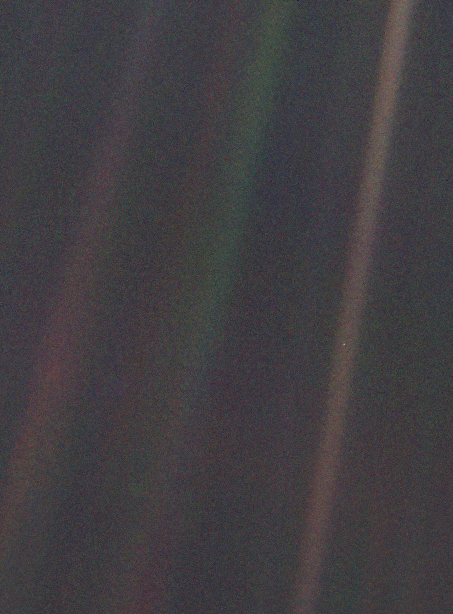
But first, some background. The year was 1990. The Voyager 1 spacecraft had completed its primary mission after twelve years and was about to depart the solar system forever. Dr. Carl Sagan, realizing that it was likely we would never again get the chance to get a "family portrait" of the Solar system from that vantage point, managed to convince NASA that they needed to turn the craft around and have it take a picture of all visible planets (Earth, Venus, Neptune, Uranus, Jupiter, and Saturn) from the perspective of six billion kilometers away from Earth.
That's 6,000,000,000 kilometers — approximately 3.7 billion miles. So far away, messages from Voyager 1 to Earth took nearly 5.5 hours to reach us at the speed of light.
NASA agreed. They captured images of the outer planets first, fearing that by aiming their cameras too close to the sun to include Earth and Venus, they would damage the camera. And then, finally, they aimed their camera at Earth.
The resulting image is the one we now call The Pale Blue Dot. You can see it up at the top of this post. Click it and you'll go to a larger version of it.
That brown streak is an artifact of how close to the sun the cameras were aimed in order to capture Earth. It isn't a real structure.
What is real is that tiny blue pixel in the streak. That tiny blue point of light — smaller than a full pixel — is Earth.
Here are Dr. Sagan's words. The ones that bring a tear to my eye.
From this distant vantage point, the Earth might not seem of any particular interest. But for us, it's different. Consider again that dot. That's here. That's home. That's us. On it everyone you love, everyone you know, everyone you ever heard of, every human being who ever was, lived out their lives. The aggregate of our joy and suffering, thousands of confident religions, ideologies, and economic doctrines, every hunter and forager, every hero and coward, every creator and destroyer of civilization, every king and peasant, every young couple in love, every mother and father, hopeful child, inventor and explorer, every teacher of morals, every corrupt politician, every "superstar," every "supreme leader," every saint and sinner in the history of our species lived there – on a mote of dust suspended in a sunbeam.
The Earth is a very small stage in a vast cosmic arena. Think of the rivers of blood spilled by all those generals and emperors so that in glory and triumph they could become the momentary masters of a fraction of a dot. Think of the endless cruelties visited by the inhabitants of one corner of this pixel on the scarcely distinguishable inhabitants of some other corner. How frequent their misunderstandings, how eager they are to kill one another, how fervent their hatreds. Our posturings, our imagined self-importance, the delusion that we have some privileged position in the universe, are challenged by this point of pale light. Our planet is a lonely speck in the great enveloping cosmic dark. In our obscurity – in all this vastness – there is no hint that help will come from elsewhere to save us from ourselves.
The Earth is the only world known, so far, to harbor life. There is nowhere else, at least in the near future, to which our species could migrate. Visit, yes. Settle, not yet. Like it or not, for the moment, the Earth is where we make our stand. It has been said that astronomy is a humbling and character-building experience. There is perhaps no better demonstration of the folly of human conceits than this distant image of our tiny world. To me, it underscores our responsibility to deal more kindly with one another and to preserve and cherish the pale blue dot, the only home we've ever known.
To me, those three paragraphs pretty much sum up my view of our place in the universe. Why it's so important to further our knowledge and turn away from unprovable beliefs and ideologies that do nothing but stifle progress in the name of petty arguments over what amounts to nothing. Belief isn't going to save mankind from whatever our species' eventual fate might be, whether it's extinction by our own hands or something we have no control over, like a new disease, environmental disaster, or a big rock hitting our planet.
Science might. There are no guarantees. But there is no evidence that anyone is watching over us, ready to save us if we just know the right words to use when asking. Or ready to punish the entirety of our species for the infractions of a small percentage because of some foolish, petty whimsy. "You don't deserve to live, because you ate meat on a Friday. Pushed a button. Wore two kinds of fabric. Ate meat from the wrong animal. Loved the wrong person. Didn't bow to the east to recite your prayers. Listened to the wrong leader. Drank the wrong drink. Thought the wrong thoughts. Believed the wrong things."
If we're going to survive, it will be because men and women of science, not faith3, figured it out. And that is what I have faith4 in.

Today's post is inspired by GBE2 (Group Blogging Experience)'s Week 115 prompt: Faith.
- I realize now that categorizing these books as 'non-fiction' is laughable, but at the time, that is how they were marketed. Which is one reason I probably had such a protracted period of time when I believed whole-heartedly in such nonsense: after all, "They" wouldn't allow a book to claim it was non-fiction if it wasn't, would They?
- Actual non-fiction! Like Carl Sagan's books and stuff by people with real edumacashuns and degrees from universities that aren't made up. People who have Science and Data to back up their claims instead of a lot of supposition and things they have extracted from their own asses.
- As in belief with no evidence — or even in defiance of evidence to the contrary — which is what is usually meant when used in this sense.
- Evidence-based trust, as in, "I have faith the sun will rise tomorrow," because we have scientific evidence, not because someone sang it into the sky or sacrificed a virgin to it or prayed it out of the darkness.
Wednesday, May 29, 2013
You Done STEPPED in it Now


Earlier this week, Pope Francis I made history by announcing that not only do all good people go to heaven (stating that, basically, good acts are what count), this included, of all people, atheists.
Gasp! The scandal!
A lot of atheists were quite amused by this. “Yay, we’re not going to the imaginary happy place instead of not going to the imaginary bad place!”
I, personally, view the Pope’s announcement as roughly equivalent to Bugs Bunny telling me I’ll go to Los Ang-ga-leez after I die, but only if I take a left turn at Albuquerque.
But not long after the Pope made his announcement, the Vatican contradicted this.
[T]he Rev. Thomas Rosica, a Vatican spokesman, said that people who know about the Catholic church “cannot be saved” if they “refuse to enter her or remain in her.”
(Translation: Atheists are going to Hell if they don’t accept Jesus Christ as Lord and Saviour.) [emphasis added]
I’m mighty glad the article provided that translation, because otherwise I might have thought he was implying something else altogether. If you know what I mean. Nudge-nudge.
But let’s ignore that. As I said, I find the whole thing kind of amusing. Sort of the same way a Christian would if a Native American shaman told them they would not be able to enter the Happy Hunting Ground because they were not Cherokee (or whatever). “Oh, that’s nice.” <polite smile>
What I’m curious about is this whole papal infallibility thing. You know, the doctrine that states that whatever the Pope says is what the church believes?
From Wikipedia, the bastion of all knowledge:
Papal infallibility is a dogma of the Catholic Church which states that, in virtue of the promise of Jesus to Peter, the Pope is preserved from the possibility of error "when, in the exercise of his office as shepherd and teacher of all Christians, in virtue of his supreme apostolic authority, he defines a doctrine concerning faith or morals to be held by the whole Church.” [emphasis added]
<insert screeching tire noise here>
So, how does this work, exactly? The pope, Il Papa, The Dude with the Funny Hat himself, comes out and proclaims, “Anyone who does good can get into Heaven,” this should mean that from that point forward (Or is it retroactive?), this is the doctrine of the entire Catholic church. (Until the next infallible Pope says the opposite, anyway.) No ifs, ands, or buts about it:1 if The Pope says it, that’s the way it is.
Except that then the Vatican – represented by a priest who is not the Pope – comes out a few days later and says, “Wait, no. The Pope was wrong.”
<insert sound of game show buzzer here>
“Oh, I’m sorry. You forgot to state the doctrine in the form of a papal proclamation.”
To me, this is a much more interesting question than whether people who don’t believe are or are not going to a place they don’t believe in after they die. Is the church abandoning papal infallibility? Was it ever a thing? Am I misinterpreting something?2
Or is this, indeed, a big doctrinal, dogmatic deal?
What are your thoughts?
- I believe this is the basis for papal infallibility, or at least that’s what Professor Wiki tells me: Matthew 16:18 And I say also unto thee, That thou art Peter, and upon this rock I will build my church; and the gates of hell shall not prevail against it. 19 And I will give unto thee the keys of the kingdom of heaven: and whatsoever thou shalt bind on earth shall be bound in heaven: and whatsoever thou shalt loose on earth shall be loosed in heaven. [emphasis added, clearly]
- I am quite aware of this, also from Wikipedia: "A doctrine proposed by a pope as his own opinion, not solemnly proclaimed as a doctrine of the Church, may be rejected as false, even if it is on a matter of faith and morals, and even more any view he expresses on other matters." So, yeah, all they have to do is say it was his opinion or that he was not making a binding claim and they're off the hook, but I find this loophole kind of hypocritical. Don't you think? I mean, a Pope either is or is not infallible. If he can make one mistake, doesn't that mean he is, pretty much by definition, fallible?
Friday, January 18, 2013
Improbability

Take a deck of 52 standard playing cards (remove the jokers and any ad cards), or, if you have them handy, you could use a standard deck of 78 tarot cards as well. If you want to be evil and possibly murder some random person.
I keed, I keed! You won't cause random murder with a tarot deck. Probably.
Shuffle them at least six times to ensure a more random order. (Seven if using the tarot deck.)
Cut the deck. Or don't. I don't really care.
Now, deal the cards out one at a time, face-up, on a table, floor, or other flat surface so that you can see all the cards.
When you're done, carefully examine the order of the cards that you've laid out, from left to right.
That particular sequence of cards that you laid out was so improbable that it was impossible, by all practical definitions of the word. It had roughly a 1 in 8.06582 x 1067 chance of occurring! (Or 1 in ~1.13243 x 10115 if you used the tarot deck.) If a machine that could sort and deal the entire deck of cards in one second were to start doing so at the moment of the big bang, it still would not have exhausted all the possible combinations of cards in the 52-card deck, much less the 78-card tarot deck. The universe is only a bit over 432 quadrillion seconds old. That's ~ 4.3233 x 10¹⁷ seconds. You'll notice that 17 is much smaller than both 67 and 115.
And yet, this extremely improable event occurred right before your eyes. You watched it unfold before you! How astounding! You've just witnessed something that has almost certainly never occurred before, and will almost certainly never occur again in the history of the universe.
Do you feel privileged? As though you've witnessed a miracle that requires a "guiding hand" from elsewhere so that it aligned just right?
Eh, probably not. I mean, it's just random card order, right?
People tend to ascribe higher "impossibility" to sequences of events that mean something to them. Like flipping a coin a hundred times and coming up with heads every single time. In reality, any sequence of a hundred flips of the coin is equally unlikely as a hundred heads, a hundred tails, or fifty of each, intermingled (HTHT . . .).
Admit it: if you did the shuffle-then-layout thing and the cards managed to be in order from ace to king by suit (spades, hearts, diamonds, then clubs), or in a similar order for the Tarot cards, with the minor arcana first by number and suit, followed by the major arcana, you'd be much more likely to get a cold chill up your spine. But those "special" arrangements are exactly as likely — or as unlikely — as any other one.
Or if you shredded a catalog into confetti, then tossed it all up into the air over a fan, and as the pieces drifted to the ground, it happened to form an image that looked like Jesus or the virgin Mary, suddenly, it's a miracle! Whereas, if it formed the equally unlikely picture of, say, Flo the cashier from those Progressive Insurance commercials or Pepe le Pew, the Loony Toons skunk, it would be kind of neat . . . but hardly miraculous. They only seem miraculous because the image formed means something to us.
If it actually formed the unmistakable image of anything, I'd be highly suspicious. That our brains see patterns where there aren't any is called "pareidolia," and it's a well-known explanation for such things as Jesus-tortillas or Virgin-Mary-grilled-cheese-sandwiches.1
This is why I tend to be scornful when I hear things like "the universe has to have had a creator because there's no way everything just happened to line up to allow our kind of life!" If you look into it a bit, you realize that there's more beauty to the universe without a guiding intelligence than with one, or at least that's how I see it.
- Frankly, the Virgin Mary grilled cheese (see the image at the top of this post) doesn't look like much of anything to me, but sometimes I can sort of see an image of Tracy Scoggins, if I look slightly to one side and squint. And it's dark enough. And someone tells me I'm supposed to see Mary/Tracy.
Tuesday, May 03, 2011
Let the Punishment Fit the Father's Crime
I'm reading a book called The Book of Were-Wolves published in 1865 by Sabine Baring-Gould. Here is my rough Modern English translation (it used a lot of Scots dialect and archaic words) of a story he tells of a Scottish punishment that I found particularly gruesome.
So, let's look at this. She was a year old when her family was burnt for being cannibals. Although she could not remember it, no doubt she tasted human flesh as a child. Had they just left well enough alone and raised her not to know her past, she probably would have turned out a fine, upstanding member of the community.
But did they? No. They poisoned her with stories of her family's crimes throughout her entire childhood, making sure that she knew exactly what foul stock she came from. Some versions of the story (I looked it up) say that during her childhood, she would often bite other children on the fingers and suck their blood. I don't know how much credence to put to that, but the crux of the point is this: She would have had no way of knowing the crimes of her family if they hadn't bludgeoned her with it throughout her entire childhood. If she did later harm other children and attempt to eat them, who could blame her? (I'm getting to that.)
The part that chills my blood, though, is that on a website where I found this story, it had this to say.
Yes, I'm speculating about the whole "making sure she knew she was the spawn of evil" part because we know for a fact that you can't "catch" cannibalism. She wouldn't have had any idea at all if they hadn't made sure that she did. Probably with every waking moment of every day of her miserable existence.
But, hey. What can you say? It's right there in the Bible, so it must be good and loving and moral and correct. Ex 34:6-7.
But what do I know. I'm just an atheist. I have no morals. I can't tell right from wrong unless it's explained to me. I'm sure someone will come along any minute now to explain to me how it makes sense to blame an infant for the actions of her family. Yep, any minute, now.
Any. Minute. Now . . .
About this time (1460), there was a brigand taken with his whole family, who haunted1 a place in Angus. This mischievous man had an execrable habit to take all young men and children he could steal away quietly, or take away without knowledge, and eat them, and the younger they were, esteemed them the more tender and delicious. For which cause and damnable abuse, he with his wife and children were all burnt, except a young girl of a year old who was saved and brought to Dundee, where she was brought up and fostered; and when she came to a woman's years, she was condemned and burnt quick for that crime. It is said that when she was coming to the place of execution, there gathered a huge multitude of people, and specially of women, cursing her that she was so unhappy [as] to commit so damnable deeds. To whom she turned about with an ireful countenance, saying, "Why chide me, as if I had committed an unworthy act? Give me credence and trust me: if you had experience of eating men and women's flesh, you would think it so delicious that you would never forbear it again." So but any sign of repentance, this unhappy traitor died in the sight of the people.[Quoted from the aforementioned book, but with liberties taken to replace archaic words and Scots dialect with more modern equivalents to the best of my meager ability.]
So, let's look at this. She was a year old when her family was burnt for being cannibals. Although she could not remember it, no doubt she tasted human flesh as a child. Had they just left well enough alone and raised her not to know her past, she probably would have turned out a fine, upstanding member of the community.
But did they? No. They poisoned her with stories of her family's crimes throughout her entire childhood, making sure that she knew exactly what foul stock she came from. Some versions of the story (I looked it up) say that during her childhood, she would often bite other children on the fingers and suck their blood. I don't know how much credence to put to that, but the crux of the point is this: She would have had no way of knowing the crimes of her family if they hadn't bludgeoned her with it throughout her entire childhood. If she did later harm other children and attempt to eat them, who could blame her? (I'm getting to that.)
The part that chills my blood, though, is that on a website where I found this story, it had this to say.
There was no hope of saving this poor child and the only solution was to execute her. The Dundee authorities were not heartless, however, and could not execute such a young person . . . they waited till she was eighteen then burned her alive in the Seagate.So, once again: These good, "not heartless" Christian people burned an entire family alive except for one infant, raised that infant until she was 18, made sure that she knew full well for her entire life that she was evil, then, when she was 18, burned her for her family's crimes.
Yes, I'm speculating about the whole "making sure she knew she was the spawn of evil" part because we know for a fact that you can't "catch" cannibalism. She wouldn't have had any idea at all if they hadn't made sure that she did. Probably with every waking moment of every day of her miserable existence.
But, hey. What can you say? It's right there in the Bible, so it must be good and loving and moral and correct. Ex 34:6-7.
And the LORD passed by before him, and proclaimed, The LORD, The LORD God, merciful and gracious, longsuffering, and abundant in goodness and truth, keeping mercy for thousands, forgiving iniquity and transgression and sin, and that will by no means clear the guilty; visiting the iniquity of the fathers upon the children, and upon the children's children, unto the third and to the fourth generation.Boy, I'm glad their god is a merciful, gracious, good, and loving god, because otherwise, their actions sure do sound like cold, calculated evil. To me.
But what do I know. I'm just an atheist. I have no morals. I can't tell right from wrong unless it's explained to me. I'm sure someone will come along any minute now to explain to me how it makes sense to blame an infant for the actions of her family. Yep, any minute, now.
Any. Minute. Now . . .
- In the sense of visiting habitually, not our more modern meaning.
Published with Blogger-droid v1.6.8
Monday, January 26, 2009
People Are People, Unfortunately
Back in November, after more than two years of being in a Yahoo group that I participated in off and on, I removed myself from their membership.
The group was the Atlanta Freethought Society, of which I'm still a paying member until March, and at which point I will not renew.
The list is populated mostly by snarky, older, left- or central-leaning atheists and agnostics who used the list to comment on news stories and such, usually having to do with the clash between the religious and the non-religious or anti-religious, but also including "woo" topics like Bigfoot or alien abduction.
And I'm okay with that. These are my peeps when it comes to that. Who better to appreciate stories of ignorant people in some backward, podunk town expelling a teenage girl from high school on the grounds that she's a witch? The list abounded with stuff like this, day in and day out, for most of the time I was on it.
Last summer, I went to one in-person meeting of the group and was not impressed, but still remained on the email list.
And then, the Troll occurred.
The group acquired a troll back sometime during the summer. He was from Indianapolis, which was clearly stated in his Yahoo bio. Yeah, we're the Atlanta Freethought Society, but there's nothing in the charter (I checked) that said only people from the Atlanta environs could join and participate. In fact, there is nothing anywhere that states that a person has to believe, not believe, think, or not think anything in order to participate. I want to say this up front because it becomes important later.
So, this guy whom I'll call "Jim" starts posting to our group. It becomes readily apparent from the get-go that Jim is a Christian, because he takes every opportunity to make sure that we knew this. Not in what I'd call an obnoxious way, at all, but simply stated as part of his responses.
Now, when you have a list of people who all believe in X and you introduce someone who believes in !X, it will inevitably cause some conflict. The sane response for the X people is to ignore the !X person, and eventually the !X person will get bored and go away.
Right?
Well, actually, no one has ever tested this hypothesis, nor are they ever likely to. Because, like the question of how many licks it takes to get to the Tootsie Roll center of a Tootsie Pop, no one has ever gotten past three. :) People are constitutionally unable to ignore a troll. Trolls, knowing this, gleefully stay where they are clearly not wanted, because their sole purpose in life is to stir up trouble. But I digress.
People in the Atlanta Freethought Society—and I stress this to point out the absurdity of what you're about to learn—attacked. Mercilessly. Because he didn't agree with their point of view. "Hey, idiot, this is an atheist group, and so all your preaching isn't appreciated!" was the general tone of most of it. A few people popped up at this point and said, "Actually, you know, it's a free-thought group, and I'm {an agnostic|a deist|a theist|whatever}," but these people were ignored or shouted down.
Jim stated on several occasions that he was there to learn and be exposed to other points of view. He stated that although he was a Christian, he had no truck with organized religion, hated the Catholic church1, was in complete favor of church-state separation, etc. The only substantial way that he differed from the majority of our group was that he was not an avowed atheist or agnostic.
As soon as people started snarking off at him, he started snarking back. And so the snark got snarkier and snarkier until it was barely concealed (or just plain raw) contempt.
Where I got involved was when someone just out of the blue asked Jim if he was a "reformed" homosexual. In other words, a gay man whose Christian values have convinced him to deny his nature and proclaim he's "cured" of homosexuality.
Whoa. Where did that come from? So I jumped in. "What does Jim's sexual orientation have to do with anything?" I asked. "We were talking about <whatever>."
"Well, he just sounds like he's one of those guys. He has all the hallmarks," came the reply.
"But why does that matter? What does whether he's straight, gay, bisexual, transsexual, or something else have to do with the issue you're arguing with him about?"
"He's a troll! And I have to make him admit he's gay! Because he's gay! And until he admits he's gay, he's dishonest!" (I wish I were making this up. This is not a direct transliteration, obviously, but it captures the spirit of what was said.)
It went on like this for several more exchanges. People were getting downright nasty. And then a couple of the gay people on the list got involved, and were actually supporting this nonsense, calling for Jim to admit to his homosexuality. Which he did, openly. He claimed that, like me, he just had no clue why it was such an issue, and didn't answer because it was not relevant. But eventually, he said, "Yeah, I'm gay. I'm proudly gay, out, and have been for 30 years. Now what?"
So they they started in with the "Aha! I thought so!" nonsense, even though they didn't seem to remember that the entire brunt of their argument had been that he was trying to hide something. They then quoted all the parts of the bible back to him that have been used on a bunch of religious sites to condemn homosexuality.
Do you see it? Right there. They became the very people they claim to be fighting against. Here were a bunch of avowed atheists and agnostics using the Bible to try to catch a gay Christian man in a contradiction.
What the hell is wrong with people? I mean it. There has to be something just wrong in our heads to make us do this kind of crap.
It reminded me all too much of scenes in Frankenstein movies where the villagers have pitchforks and torches and they're all yelling at once and waving their weapons at the poor monster.
That really opened my eyes. I started to pay more attention to not only what was being said but who was saying it and how it was being said. I never did get back into participating at my usual level. I started looking at what was really being said behind the posts, and I decided it wasn't my kind of message. But that was later. Back to the summer.
One other person joined me in a call for civility (for which, incidentally, I was given grief), and for a couple of weeks, most people (there are always a few who just can't keep anything civil) treated Jim as a visitor, took him at his word that he was there to share ideas and learn different points of view, and basically engaged in a conversation instead of a verbal fist-fight.
It didn't last long, though, and soon, the gloves were back on and the moderator (who, although he didn't participate in the flame war, took no steps to try to end it, either) ended up banning Jim from the group. I state again that Jim did nothing wrong, because there is nothing in the charter that said his beliefs--or lack thereof--had to be in lockstep with the rest of the group in order to participate.
But it really showed what these people are made of. At the very first hint of an opinion that didn't match their own, they started shouting "Faggot!" and throwing figurative stones. And one of the very people shouting "faggot" the loudest was a self-avowed lesbian in a long-term relationship. It boggles the mind, really. I stress again that these are self-proclaimed free-thinkers, who are supposed to welcome discourse on a variety of topics and from a wide range of points of view.
I mean, isn't that what free-thought is all about?
Instead, this group turns out to be nothing but a cabal of back-patting, self-congratulatory jerks who just want a captive forum where they can bash religion and right-wingers—well, basically anyone who disagrees with them—at will.
The group was the Atlanta Freethought Society, of which I'm still a paying member until March, and at which point I will not renew.
The list is populated mostly by snarky, older, left- or central-leaning atheists and agnostics who used the list to comment on news stories and such, usually having to do with the clash between the religious and the non-religious or anti-religious, but also including "woo" topics like Bigfoot or alien abduction.
And I'm okay with that. These are my peeps when it comes to that. Who better to appreciate stories of ignorant people in some backward, podunk town expelling a teenage girl from high school on the grounds that she's a witch? The list abounded with stuff like this, day in and day out, for most of the time I was on it.
Last summer, I went to one in-person meeting of the group and was not impressed, but still remained on the email list.
And then, the Troll occurred.
The group acquired a troll back sometime during the summer. He was from Indianapolis, which was clearly stated in his Yahoo bio. Yeah, we're the Atlanta Freethought Society, but there's nothing in the charter (I checked) that said only people from the Atlanta environs could join and participate. In fact, there is nothing anywhere that states that a person has to believe, not believe, think, or not think anything in order to participate. I want to say this up front because it becomes important later.
So, this guy whom I'll call "Jim" starts posting to our group. It becomes readily apparent from the get-go that Jim is a Christian, because he takes every opportunity to make sure that we knew this. Not in what I'd call an obnoxious way, at all, but simply stated as part of his responses.
Now, when you have a list of people who all believe in X and you introduce someone who believes in !X, it will inevitably cause some conflict. The sane response for the X people is to ignore the !X person, and eventually the !X person will get bored and go away.
Right?
Well, actually, no one has ever tested this hypothesis, nor are they ever likely to. Because, like the question of how many licks it takes to get to the Tootsie Roll center of a Tootsie Pop, no one has ever gotten past three. :) People are constitutionally unable to ignore a troll. Trolls, knowing this, gleefully stay where they are clearly not wanted, because their sole purpose in life is to stir up trouble. But I digress.
People in the Atlanta Freethought Society—and I stress this to point out the absurdity of what you're about to learn—attacked. Mercilessly. Because he didn't agree with their point of view. "Hey, idiot, this is an atheist group, and so all your preaching isn't appreciated!" was the general tone of most of it. A few people popped up at this point and said, "Actually, you know, it's a free-thought group, and I'm {an agnostic|a deist|a theist|whatever}," but these people were ignored or shouted down.
Jim stated on several occasions that he was there to learn and be exposed to other points of view. He stated that although he was a Christian, he had no truck with organized religion, hated the Catholic church1, was in complete favor of church-state separation, etc. The only substantial way that he differed from the majority of our group was that he was not an avowed atheist or agnostic.
As soon as people started snarking off at him, he started snarking back. And so the snark got snarkier and snarkier until it was barely concealed (or just plain raw) contempt.
Where I got involved was when someone just out of the blue asked Jim if he was a "reformed" homosexual. In other words, a gay man whose Christian values have convinced him to deny his nature and proclaim he's "cured" of homosexuality.
Whoa. Where did that come from? So I jumped in. "What does Jim's sexual orientation have to do with anything?" I asked. "We were talking about <whatever>."
"Well, he just sounds like he's one of those guys. He has all the hallmarks," came the reply.
"But why does that matter? What does whether he's straight, gay, bisexual, transsexual, or something else have to do with the issue you're arguing with him about?"
"He's a troll! And I have to make him admit he's gay! Because he's gay! And until he admits he's gay, he's dishonest!" (I wish I were making this up. This is not a direct transliteration, obviously, but it captures the spirit of what was said.)
It went on like this for several more exchanges. People were getting downright nasty. And then a couple of the gay people on the list got involved, and were actually supporting this nonsense, calling for Jim to admit to his homosexuality. Which he did, openly. He claimed that, like me, he just had no clue why it was such an issue, and didn't answer because it was not relevant. But eventually, he said, "Yeah, I'm gay. I'm proudly gay, out, and have been for 30 years. Now what?"
So they they started in with the "Aha! I thought so!" nonsense, even though they didn't seem to remember that the entire brunt of their argument had been that he was trying to hide something. They then quoted all the parts of the bible back to him that have been used on a bunch of religious sites to condemn homosexuality.
Do you see it? Right there. They became the very people they claim to be fighting against. Here were a bunch of avowed atheists and agnostics using the Bible to try to catch a gay Christian man in a contradiction.
What the hell is wrong with people? I mean it. There has to be something just wrong in our heads to make us do this kind of crap.
It reminded me all too much of scenes in Frankenstein movies where the villagers have pitchforks and torches and they're all yelling at once and waving their weapons at the poor monster.
That really opened my eyes. I started to pay more attention to not only what was being said but who was saying it and how it was being said. I never did get back into participating at my usual level. I started looking at what was really being said behind the posts, and I decided it wasn't my kind of message. But that was later. Back to the summer.
One other person joined me in a call for civility (for which, incidentally, I was given grief), and for a couple of weeks, most people (there are always a few who just can't keep anything civil) treated Jim as a visitor, took him at his word that he was there to share ideas and learn different points of view, and basically engaged in a conversation instead of a verbal fist-fight.
It didn't last long, though, and soon, the gloves were back on and the moderator (who, although he didn't participate in the flame war, took no steps to try to end it, either) ended up banning Jim from the group. I state again that Jim did nothing wrong, because there is nothing in the charter that said his beliefs--or lack thereof--had to be in lockstep with the rest of the group in order to participate.
But it really showed what these people are made of. At the very first hint of an opinion that didn't match their own, they started shouting "Faggot!" and throwing figurative stones. And one of the very people shouting "faggot" the loudest was a self-avowed lesbian in a long-term relationship. It boggles the mind, really. I stress again that these are self-proclaimed free-thinkers, who are supposed to welcome discourse on a variety of topics and from a wide range of points of view.
I mean, isn't that what free-thought is all about?
Instead, this group turns out to be nothing but a cabal of back-patting, self-congratulatory jerks who just want a captive forum where they can bash religion and right-wingers—well, basically anyone who disagrees with them—at will.
- This seems to be a common misunderstanding of non-believers by believers. They believe that all of us hate the church. Yes, there are some non-believers who fall into the "anti-theist" category who believe that all religion should be abolished. There are others, like myself, who don't care what religion you are as long as you don't proselytize us.
Tuesday, April 29, 2008
On Being Abrasive About Atheism
I composed this as a response to a post on a freethought forum I belong to. It got long, and I decided to put it here, as well.
There are a good number of nutjobs on both sides of the fence (and probably a few who sit on the fence, too). I mean, Ann Coulter and Bill O'Reilly are almost in a class by themselves for the amount of truly offensive crap they spew into the environment.
But one thing about them is this: people talk and have opinions about what they say. They are brash, harsh, abrasive, blunt, opinionated, and completely and totally in-your-face about what they say and believe. They don't give a rat's ass about who they offend. Their job is to be that person. To be the total nutjob who takes things that extra step, who says things that no sane person would believe, but who make people think and react and talk about them, and perhaps examine their own viewpoints more closely than they ever would have done without the provocation.
And Hitchens and Dawkins are doing the same thing for "our" side. Dawkins says that bringing a child up in any religion is child abuse. Do I agree with that? Maybe a little, in principle, but I wouldn't go that far. The same goes for some of the things Hitchens says. But it got them noticed. People know who they are. People talk about what they say. They are brash, harsh, abrasive, blunt, opinionated, and completely and totally in-your-face about what they say and believe. They don't give a rat's ass about who they offend.
A lot of parallels get drawn between the "rationalism movement" and the "gay movement." It must be working at least in part, because gay people are less reviled by society as a whole, now, than atheists are. If you believe the polls. And what did it take? A lot of people decided they'd had enough of being marginalized, put down, and discriminated against for something they couldn't control. They became brash, harsh, abrasive, blunt, opinionated, and completely and totally in-your-face about what they said and believed. They didn't give a rat's ass about who they offended. Don't want to see two men or two women dance together, hold hands, or kiss? "Then look away," they said, "because we're not going to go away."
Love them or hate them, Dawkins and Hitchens (and others) are doing something that needs to be done just to compete for air time. Do you think Ann Coulter would get the kind of recognition she gets if she was polite but firm about her beliefs? No! Making that quip about how she'd have to go to therapy if she called Senator Edwards "gay" was one of the most successful things for her career that she's ever done. It was offensive on so many levels that almost everyone out there had an opinion about it. And it got talked about. And people thought about what she said and why it was offensive (or wasn't). If Bill O'Reilly were anything other than the asshole he is, no one would know his name, because he'd be some third-rate reporter working in some podunk market instead of Fox News. But as it is, very few people don't know his name, and the ones that do have an opinion about him one way or the other. Again, because of the way he says what he says, he makes you think about why it offends you or doesn't. I could include Stephen Colbert, Jon Stewart, and even Keith Olbermann in the same category, but on different levels and with different goals.
I guess my point is that we need MORE people like Dawkins and Hitchens. Maybe people in general really do instinctively understand that for every complete nutjob you see out there saying outrageous things, you have a legion of decent, honest people who believe some of the same things, but aren't so in-your-face about it. Penn & Teller come part of the way on their show on ShowTime, but they aren't mainstream enough, yet, to get the kind of reaction that the other guys do. Randi mostly takes on people that the majority already know are charlatans. In the big scheme of things, the Sylvia Brownes, Uri Gellers, and John Edwardses of the world are small potatoes compared to the issues that Dawkins and Hitchens and a few others are taking on. I hope Roseanne Barr is an atheist. I think Kathy Griffin is. Maybe we need a few more abrasive people out there making an issue out of it so that it gets in the public's craw and makes them a little uncomfortable. "Gee, what if the neighbors are atheists? Does that mean they're suddenly bad people?" (Maybe I'm giving the public too much credit, but maybe not.)
I'm not overly fond of some of the things Dawkins says, either, to be honest. I think he goes too far. I'm not as harsh as he is, but I make no qualms about my atheism, either. I've laid it pretty raw on my other journal a number of times, and I've lost a few friends over it, but the majority of them stay even though the vast majority of them disagree with me. Because even though I rant and rave, I try to do it in an entertaining way, at least, to get across the message that I have my passions and my windmills, too, and I'm not all that different than they are.
I think the biggest compliment I've ever gotten on that front is a passive one. My father's family--almost all of whom are devout Southern Baptists--have no idea that I'm an atheist, except for a couple of cousins. I don't make it a secret, but most of them don't see it because...I'm nice. I'm pleasant. I don't eat babies, worship Satan, or murder and rape indiscriminately or any of the other horrible things they've been taught that we nasty ol' atheists do. I don't chant Latin backwards while they're saying grace before Thanksgiving. My hope is that as the knowledge of my atheism trickles through the family (and it will), they'll be able to look at me as a positive example that you can be an atheist and have morals, be a nice person, support charities, and even--gasp!--love your family, all without God being necessary.

There are a good number of nutjobs on both sides of the fence (and probably a few who sit on the fence, too). I mean, Ann Coulter and Bill O'Reilly are almost in a class by themselves for the amount of truly offensive crap they spew into the environment.
But one thing about them is this: people talk and have opinions about what they say. They are brash, harsh, abrasive, blunt, opinionated, and completely and totally in-your-face about what they say and believe. They don't give a rat's ass about who they offend. Their job is to be that person. To be the total nutjob who takes things that extra step, who says things that no sane person would believe, but who make people think and react and talk about them, and perhaps examine their own viewpoints more closely than they ever would have done without the provocation.
And Hitchens and Dawkins are doing the same thing for "our" side. Dawkins says that bringing a child up in any religion is child abuse. Do I agree with that? Maybe a little, in principle, but I wouldn't go that far. The same goes for some of the things Hitchens says. But it got them noticed. People know who they are. People talk about what they say. They are brash, harsh, abrasive, blunt, opinionated, and completely and totally in-your-face about what they say and believe. They don't give a rat's ass about who they offend.
A lot of parallels get drawn between the "rationalism movement" and the "gay movement." It must be working at least in part, because gay people are less reviled by society as a whole, now, than atheists are. If you believe the polls. And what did it take? A lot of people decided they'd had enough of being marginalized, put down, and discriminated against for something they couldn't control. They became brash, harsh, abrasive, blunt, opinionated, and completely and totally in-your-face about what they said and believed. They didn't give a rat's ass about who they offended. Don't want to see two men or two women dance together, hold hands, or kiss? "Then look away," they said, "because we're not going to go away."
Love them or hate them, Dawkins and Hitchens (and others) are doing something that needs to be done just to compete for air time. Do you think Ann Coulter would get the kind of recognition she gets if she was polite but firm about her beliefs? No! Making that quip about how she'd have to go to therapy if she called Senator Edwards "gay" was one of the most successful things for her career that she's ever done. It was offensive on so many levels that almost everyone out there had an opinion about it. And it got talked about. And people thought about what she said and why it was offensive (or wasn't). If Bill O'Reilly were anything other than the asshole he is, no one would know his name, because he'd be some third-rate reporter working in some podunk market instead of Fox News. But as it is, very few people don't know his name, and the ones that do have an opinion about him one way or the other. Again, because of the way he says what he says, he makes you think about why it offends you or doesn't. I could include Stephen Colbert, Jon Stewart, and even Keith Olbermann in the same category, but on different levels and with different goals.
I guess my point is that we need MORE people like Dawkins and Hitchens. Maybe people in general really do instinctively understand that for every complete nutjob you see out there saying outrageous things, you have a legion of decent, honest people who believe some of the same things, but aren't so in-your-face about it. Penn & Teller come part of the way on their show on ShowTime, but they aren't mainstream enough, yet, to get the kind of reaction that the other guys do. Randi mostly takes on people that the majority already know are charlatans. In the big scheme of things, the Sylvia Brownes, Uri Gellers, and John Edwardses of the world are small potatoes compared to the issues that Dawkins and Hitchens and a few others are taking on. I hope Roseanne Barr is an atheist. I think Kathy Griffin is. Maybe we need a few more abrasive people out there making an issue out of it so that it gets in the public's craw and makes them a little uncomfortable. "Gee, what if the neighbors are atheists? Does that mean they're suddenly bad people?" (Maybe I'm giving the public too much credit, but maybe not.)
I'm not overly fond of some of the things Dawkins says, either, to be honest. I think he goes too far. I'm not as harsh as he is, but I make no qualms about my atheism, either. I've laid it pretty raw on my other journal a number of times, and I've lost a few friends over it, but the majority of them stay even though the vast majority of them disagree with me. Because even though I rant and rave, I try to do it in an entertaining way, at least, to get across the message that I have my passions and my windmills, too, and I'm not all that different than they are.
I think the biggest compliment I've ever gotten on that front is a passive one. My father's family--almost all of whom are devout Southern Baptists--have no idea that I'm an atheist, except for a couple of cousins. I don't make it a secret, but most of them don't see it because...I'm nice. I'm pleasant. I don't eat babies, worship Satan, or murder and rape indiscriminately or any of the other horrible things they've been taught that we nasty ol' atheists do. I don't chant Latin backwards while they're saying grace before Thanksgiving. My hope is that as the knowledge of my atheism trickles through the family (and it will), they'll be able to look at me as a positive example that you can be an atheist and have morals, be a nice person, support charities, and even--gasp!--love your family, all without God being necessary.
Saturday, September 15, 2007
Atheism
I'm not sure I can articulate exactly why I'm an atheist. It's like asking someone why they breathe or blink. It's not something I think about; it's something I just am. I know that I've never really believed in a "personal" God—or gods—and paid lip-service only to fit in and because I didn't know that not believing was an option. I attended church almost every Sunday for a while when I was a child, and went to Vacation Bible School in the summer. Like a good Southern Baptist. But I never really..."got" it, if that makes sense. It never "took."
Understand: I don't have some sort of grudge against the church or god because I didn't get something I prayed for. On the contrary. Just like everyone else, I made little prayers when I was in school for dumb, silly, childish things. And like everyone else, I remembered the ones that came out the way I wanted and forgot the ones that didn't.
I can remember one instance in particular that stands out for me, because it taught me something valuable.
It was 1982 or 1983; my senior year in high school. I had done a project for the science fair every single year since the very first year we were "allowed." I say "allowed" in quotes because it wasn't really an option. But also when I say "I" had done them, that's not entirely accurate. Like most of the kids, my parents did a good portion of the work. My father was a carpenter/contractor, so he "got" to build anything that required building. The tornado box, for instance, or the solar oven. And always the tri-fold backboards that delineated the space that each project could take up. My mother helped me write the papers, and had her secretary type them up for me, so they'd look nice and professional. Thus, I usually did fairly well in the fair, but not stellar. The projects I picked were straight out of books with helpful suggestions for science fair projects. Often, more than one of us would pick the same project, and end up side-by-side at the fair.
The previous summer I had attended Capstone Summer Honors program at the University of Alabama. This gives high school juniors with high ACT scores the option of getting a head start on their college careers by allowing them to attend the first of two summer quarters while living on campus. It was a great experience. I took a computer course (on a mainframe) and became hooked on computers. So when I got back home, my parents relented and allowed me to get a computer. We first selected a Timex-Sinclaire 1000 because the price was right: $99. After I quickly outpaced what that would allow me to do, my parents saw that this was not a passing obsession and let me step up to a TRS-80 Color Computer. Sixteen whole kilobytes of memory that didn't fall out of the back of the machine at the drop of a hat. I was in heaven. I quickly learned BASIC and everything kind of took off from there.
For reasons that are unclear to me, I had also gotten interested in television violence. I think I must have heard a talk on it or read an article, but it intrigued me. It was clear that it was Bad with a capital "B," but it was also clear that the networks were not about to reduce the amount of violence in their shows.
When the time came to select a topic for the science fair, it was only natural that I find a way to combine my two passions: A Statistical Analysis of Television Violence.
What I did was actually quite simple, but at the time, it seemed brilliant. To me, at least. I decided that I would analyze whether people's favorite shows were also the most violent, whether they knew this, and whether it would correlate based on age, gender or race. So I came up with a questionnaire, had my compter generate 200 random phone numbers in my home town, and I cold-called people and asked them to answer my questions over the phone. I also sent another 200 or so with my mother to take the schools in the neighboring county where she worked in the admistration of the school system.
"Hello, my name is <my name here> and I am a senior at Warrior Academy in Eutaw. I am doing a science project about television violence and I was wondering if you wouldn't mind answering a few short questions for me?" That was roughly my script. I had them tell me their favorite show, what they thought was the most violent show on television, and give me their gender, age range, and race. A few people bristled at the last question, but that's to be expected in rural Alabama. "I am a NeGRO," I remember one older man said, very defiant of what he must have assumed was some sort of racist question on my part. I was so naive of race at the time that I hadn't even included a catgory on my charts for Asian and Hispanic.
After all the questionnaires were in, I entered the data into a rudimentary "database" (at the time, I had no idea what a database was) I had designed and stored it all on a cassette tape. I wrote a program in BASIC to read the tape and correlate the questionnaire results based on whether the people realized their favorite shows were also the most violent and categorized it by age ranges, gender, and race, in every combination of the three variables. The violence information itself, by the way, came from a group called the National Coalition on Television Violence, or NCTV. They don't seem to exist any longer, as their site (http://nctvv.org) is no longer available. They provided me with the top 100 shows rated from most to least violent.
(If it matters, the results were that people did seem to realize that the shows they liked were also quite violent, but that the only real correlation was gender and age. Most prominent were the males between 18 and 24 (or whatever range I came up with). Which, coincidentally, is the demographic most advertisers at the time were trying to reach.)
What does all of this have to do with my being an atheist? I can hear you thinking it. It will become clear. Patience, Grasshopper.
So I finish my science project, Daddy built the tri-fold backboard, my mother's secretary typed up the research paper, and I took the computer, the cassette tape player, and the bound set of questionnaires to school and set it all up.
It was then that I remember saying a little prayer. "God," I thought as I exited the gym, "just let me do the best I can." That was it. No more. I knew I had done my best, and I knew that I had, for once, done the lion's share of the work.
A few hours into the judging, the principal, Mr. Costanzo, came and got me and my friend Willis out of class. "Boys," he said, "the judges are very impressed with both of your projects, and they can't decide between them for first place. So we've decided to award it to both of you."
Wow! First place! And I had done it! All by myself, within reason. Willis and I both walked around with swelled heads for a few days. The other kids were let in to view the fair in the afternoon, after the judging, and I realized pretty quickly that I had a golden opportunity. Instead of having my computer display boring statistics and information about television violence, I loaded up a game I had written. I left it running on the computer.
My display was the most popular. :)
It didn't take me long, though, to realize that God had nothing to do with my success. I had done all the hard work on my own. I designed the questionnaire, made the cold calls, wrote the program to do the analysis...I even wrote the program to generate random Eutaw phone numbers based on patterns I had noticed in the phone book. God hadn't done any of that; I had. So why give him any of the credit?
Willis and I both went to the regional fair, and both failed miserably. At Warrior Academy, we had both been big fish in a little pond; at the regional fair, we were plankton. The girl three booths down from me had done a project with a computer, as well. She built her computer. And then programmed it. By flipping switches and entering in machine code in hexadecimal. I can't help but wonder where she is, today.
Willis' display on erythrocytes was right next to a kid whose father was a professor at the University of Alabama, and had access to a scanning electron microscope. His similar project blew Willis' out of the water. We both returned home chastened, our big heads deflated. And once again, I thought, "I did my best on this." It wasn't God who had made me win by somehow influencing the judges to vote for me. And it wasn't God who had made me fail at the regional fair. No, both times it was because of me and my own abilities. At Warrior, our projects outshone the others because of the hard work and dedication we had put in. At the regional fair, ours faded into the background for the same reason: we hadn't put in as much work and dedication as the winners. It was just that simple.
When I look back on this experience, I see the first glimmer of my realization that God—or gods—simply isn't necessary. It wasn't until much later that I began to think critically and examine the scientific evidence and realize that I could no longer even give lip-service to the concept.
So that's why I remember that one, silent prayer so vividly. It was the one that led, utlimately, to a greater understanding that God wasn't necessary.
Understand: I don't have some sort of grudge against the church or god because I didn't get something I prayed for. On the contrary. Just like everyone else, I made little prayers when I was in school for dumb, silly, childish things. And like everyone else, I remembered the ones that came out the way I wanted and forgot the ones that didn't.
I can remember one instance in particular that stands out for me, because it taught me something valuable.
It was 1982 or 1983; my senior year in high school. I had done a project for the science fair every single year since the very first year we were "allowed." I say "allowed" in quotes because it wasn't really an option. But also when I say "I" had done them, that's not entirely accurate. Like most of the kids, my parents did a good portion of the work. My father was a carpenter/contractor, so he "got" to build anything that required building. The tornado box, for instance, or the solar oven. And always the tri-fold backboards that delineated the space that each project could take up. My mother helped me write the papers, and had her secretary type them up for me, so they'd look nice and professional. Thus, I usually did fairly well in the fair, but not stellar. The projects I picked were straight out of books with helpful suggestions for science fair projects. Often, more than one of us would pick the same project, and end up side-by-side at the fair.
The previous summer I had attended Capstone Summer Honors program at the University of Alabama. This gives high school juniors with high ACT scores the option of getting a head start on their college careers by allowing them to attend the first of two summer quarters while living on campus. It was a great experience. I took a computer course (on a mainframe) and became hooked on computers. So when I got back home, my parents relented and allowed me to get a computer. We first selected a Timex-Sinclaire 1000 because the price was right: $99. After I quickly outpaced what that would allow me to do, my parents saw that this was not a passing obsession and let me step up to a TRS-80 Color Computer. Sixteen whole kilobytes of memory that didn't fall out of the back of the machine at the drop of a hat. I was in heaven. I quickly learned BASIC and everything kind of took off from there.
For reasons that are unclear to me, I had also gotten interested in television violence. I think I must have heard a talk on it or read an article, but it intrigued me. It was clear that it was Bad with a capital "B," but it was also clear that the networks were not about to reduce the amount of violence in their shows.
When the time came to select a topic for the science fair, it was only natural that I find a way to combine my two passions: A Statistical Analysis of Television Violence.
What I did was actually quite simple, but at the time, it seemed brilliant. To me, at least. I decided that I would analyze whether people's favorite shows were also the most violent, whether they knew this, and whether it would correlate based on age, gender or race. So I came up with a questionnaire, had my compter generate 200 random phone numbers in my home town, and I cold-called people and asked them to answer my questions over the phone. I also sent another 200 or so with my mother to take the schools in the neighboring county where she worked in the admistration of the school system.
"Hello, my name is <my name here> and I am a senior at Warrior Academy in Eutaw. I am doing a science project about television violence and I was wondering if you wouldn't mind answering a few short questions for me?" That was roughly my script. I had them tell me their favorite show, what they thought was the most violent show on television, and give me their gender, age range, and race. A few people bristled at the last question, but that's to be expected in rural Alabama. "I am a NeGRO," I remember one older man said, very defiant of what he must have assumed was some sort of racist question on my part. I was so naive of race at the time that I hadn't even included a catgory on my charts for Asian and Hispanic.
After all the questionnaires were in, I entered the data into a rudimentary "database" (at the time, I had no idea what a database was) I had designed and stored it all on a cassette tape. I wrote a program in BASIC to read the tape and correlate the questionnaire results based on whether the people realized their favorite shows were also the most violent and categorized it by age ranges, gender, and race, in every combination of the three variables. The violence information itself, by the way, came from a group called the National Coalition on Television Violence, or NCTV. They don't seem to exist any longer, as their site (http://nctvv.org) is no longer available. They provided me with the top 100 shows rated from most to least violent.
(If it matters, the results were that people did seem to realize that the shows they liked were also quite violent, but that the only real correlation was gender and age. Most prominent were the males between 18 and 24 (or whatever range I came up with). Which, coincidentally, is the demographic most advertisers at the time were trying to reach.)
What does all of this have to do with my being an atheist? I can hear you thinking it. It will become clear. Patience, Grasshopper.
So I finish my science project, Daddy built the tri-fold backboard, my mother's secretary typed up the research paper, and I took the computer, the cassette tape player, and the bound set of questionnaires to school and set it all up.
It was then that I remember saying a little prayer. "God," I thought as I exited the gym, "just let me do the best I can." That was it. No more. I knew I had done my best, and I knew that I had, for once, done the lion's share of the work.
A few hours into the judging, the principal, Mr. Costanzo, came and got me and my friend Willis out of class. "Boys," he said, "the judges are very impressed with both of your projects, and they can't decide between them for first place. So we've decided to award it to both of you."
Wow! First place! And I had done it! All by myself, within reason. Willis and I both walked around with swelled heads for a few days. The other kids were let in to view the fair in the afternoon, after the judging, and I realized pretty quickly that I had a golden opportunity. Instead of having my computer display boring statistics and information about television violence, I loaded up a game I had written. I left it running on the computer.
My display was the most popular. :)
It didn't take me long, though, to realize that God had nothing to do with my success. I had done all the hard work on my own. I designed the questionnaire, made the cold calls, wrote the program to do the analysis...I even wrote the program to generate random Eutaw phone numbers based on patterns I had noticed in the phone book. God hadn't done any of that; I had. So why give him any of the credit?
Willis and I both went to the regional fair, and both failed miserably. At Warrior Academy, we had both been big fish in a little pond; at the regional fair, we were plankton. The girl three booths down from me had done a project with a computer, as well. She built her computer. And then programmed it. By flipping switches and entering in machine code in hexadecimal. I can't help but wonder where she is, today.
Willis' display on erythrocytes was right next to a kid whose father was a professor at the University of Alabama, and had access to a scanning electron microscope. His similar project blew Willis' out of the water. We both returned home chastened, our big heads deflated. And once again, I thought, "I did my best on this." It wasn't God who had made me win by somehow influencing the judges to vote for me. And it wasn't God who had made me fail at the regional fair. No, both times it was because of me and my own abilities. At Warrior, our projects outshone the others because of the hard work and dedication we had put in. At the regional fair, ours faded into the background for the same reason: we hadn't put in as much work and dedication as the winners. It was just that simple.
When I look back on this experience, I see the first glimmer of my realization that God—or gods—simply isn't necessary. It wasn't until much later that I began to think critically and examine the scientific evidence and realize that I could no longer even give lip-service to the concept.
So that's why I remember that one, silent prayer so vividly. It was the one that led, utlimately, to a greater understanding that God wasn't necessary.
Subscribe to:
Posts (Atom)